Title page and page numbers that start at 41
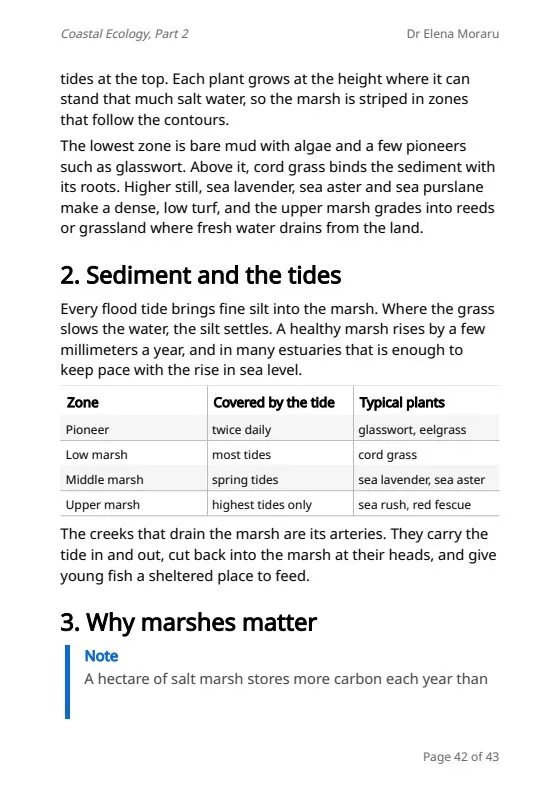
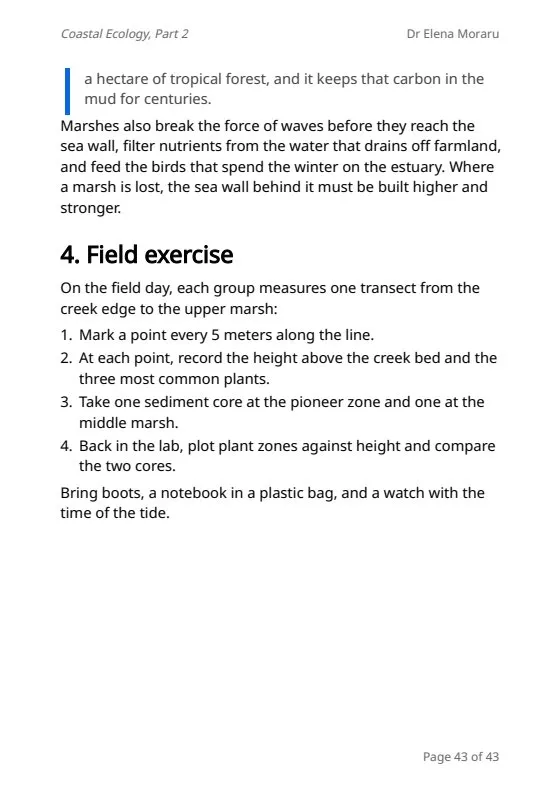
A title page without header, footer or page number, and page numbers that continue from part 1 at 41, on the right of the footer.
first: false leaves the title page bare; numbering starts at 41 on the right of the footer, to continue part 1 of a course reader.
Markdown source
Markdown · 70 lines---
title: Coastal Ecology, Part 2
author: Dr Elena Moraru
page:
size: A5
margin: 18mm 16mm 20mm
first: false
header:
left: "*{title}*"
right: "{author}"
numbering:
text: Page {page} of {pages}
position: footer right
start: 41
---
# Coastal Ecology
## Course reader, part 2: salt marshes and estuaries
**Dr Elena Moraru**
Department of Marine Science
Autumn term 2026
This first page carries the title, so it has no header, no footer and no page number: one front matter line, `first: false`, under `page:`. Part 1 of the reader ended on page 40, so part 2 starts at 41 with `start: 41`, and the number sits on the right of the footer with `position: footer right`.
| You write under `numbering:` | Effect |
|:--|:--|
| `start: 41` | The first page is page 41; `{pages}` is the number of the last page |
| `position: footer right` | The number on the right of the footer |
| `position: header` | The number in the center of the header |
| `style: i` | Roman numerals for `{page}` and `{pages}` |
| `text: Page {page} of {pages}` | The words around the number |
## 1. What a salt marsh is
A salt marsh is the band of grass and herbs between the land and the open mud of an estuary. The sea covers it at high tide, twice a day at the lowest edge and only at the highest spring tides at the top. Each plant grows at the height where it can stand that much salt water, so the marsh is striped in zones that follow the contours.
The lowest zone is bare mud with algae and a few pioneers such as glasswort. Above it, cord grass binds the sediment with its roots. Higher still, sea lavender, sea aster and sea purslane make a dense, low turf, and the upper marsh grades into reeds or grassland where fresh water drains from the land.
## 2. Sediment and the tides
Every flood tide brings fine silt into the marsh. Where the grass slows the water, the silt settles. A healthy marsh rises by a few millimeters a year, and in many estuaries that is enough to keep pace with the rise in sea level.
| Zone | Covered by the tide | Typical plants |
|:--|:--|:--|
| Pioneer | twice daily | glasswort, eelgrass |
| Low marsh | most tides | cord grass |
| Middle marsh | spring tides | sea lavender, sea aster |
| Upper marsh | highest tides only | sea rush, red fescue |
The creeks that drain the marsh are its arteries. They carry the tide in and out, cut back into the marsh at their heads, and give young fish a sheltered place to feed.
## 3. Why marshes matter
> [!NOTE]
> A hectare of salt marsh stores more carbon each year than a hectare of tropical forest, and it keeps that carbon in the mud for centuries.
Marshes also break the force of waves before they reach the sea wall, filter nutrients from the water that drains off farmland, and feed the birds that spend the winter on the estuary. Where a marsh is lost, the sea wall behind it must be built higher and stronger.
## 4. Field exercise
On the field day, each group measures one transect from the creek edge to the upper marsh:
1. Mark a point every 5 meters along the line.
2. At each point, record the height above the creek bed and the three most common plants.
3. Take one sediment core at the pioneer zone and one at the middle marsh.
4. Back in the lab, plot plant zones against height and compare the two cores.
Bring boots, a notebook in a plastic bag, and a watch with the time of the tide.
Rendered pages
PDF · 3 pages · 19 KB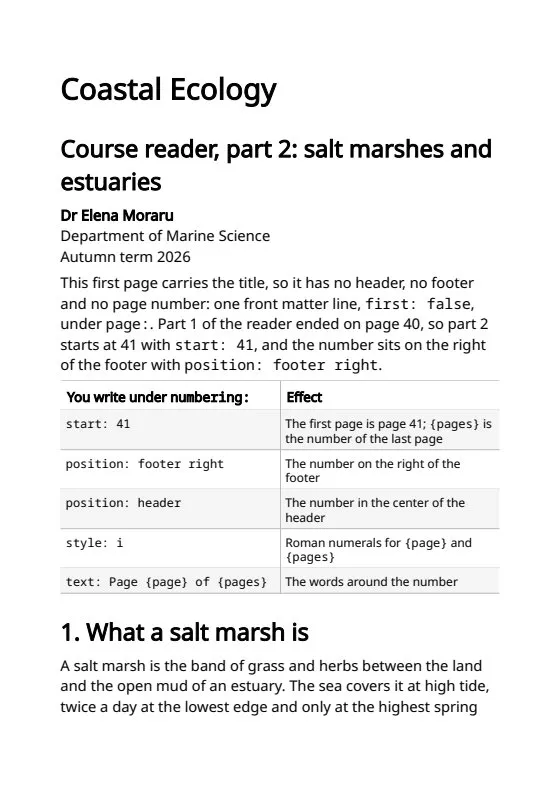
The sample documents describe invented organizations in several countries. All names and figures are illustrative.
Page setup: paper, margins, headers and footers: every sampleIn the Markdown reference